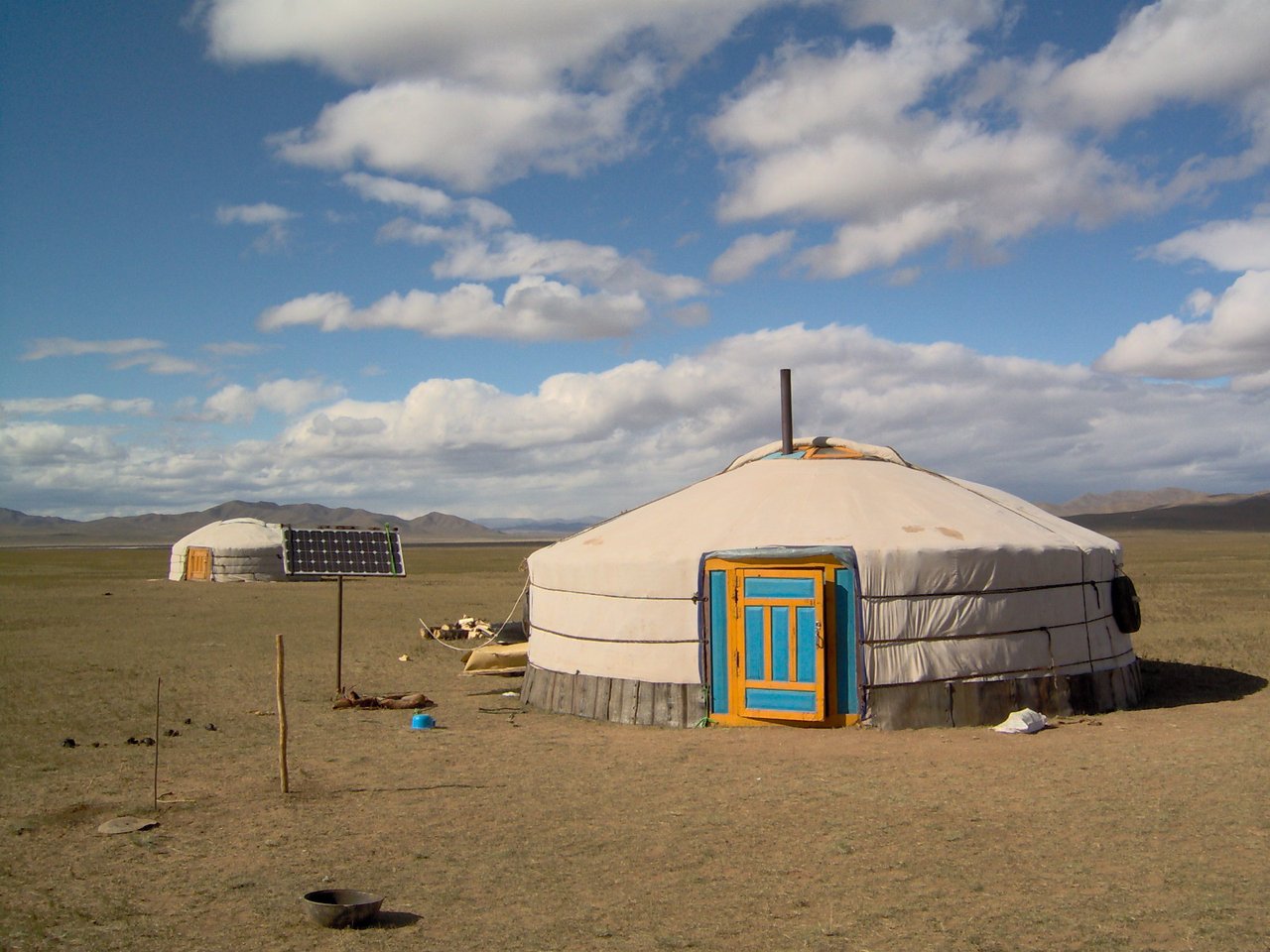
There is something about stepping into a yurt for the first time. The round wall wraps around you, the roof poles rise to a single ring of light in the centre, and the outside world goes quiet. People who have never been near Central Asia often say the same thing: it feels like home.
That feeling has deep roots. Long before “glamping” was a word, families on the open grasslands of Mongolia, Kazakhstan and Kyrgyzstan lived, married, celebrated and mourned inside round homes of wood and felt. This is a short look at where the yurt comes from, how it was made, and how it ended up in fields, gardens and woodlands across Ireland and Britain.
A home built to move
The yurt was made for people on the move. Herding families followed their animals to fresh grazing, so a house had to come down, travel and go back up again without fuss.
UNESCO, which added the craft of the Mongolian yurt to its list of the world’s intangible cultural heritage in 2013, describes the Mongolian ger (the Mongolian name for it) as “a round structure of walls, poles and a peaked roof covered with canvas and felt, and tightened with ropes”. It is, in UNESCO’s words, “light enough for nomads to carry; flexible enough to fold and pack; and sturdy enough to be dismantled and reassembled”, and it “can withstand Mongolia’s fierce spring winds”.
That is the genius of the design. There are no nails holding the walls together and no foundations. The frame works as a whole: a lattice wall that opens out like a garden trellis, roof poles that lean in from the wall to a central ring, and ropes or bands that hold everything in tension. Push on one part and the load spreads around the circle.
Two great traditions
A year later, in 2014, UNESCO recognised a second tradition: the knowledge and skills used to make Kyrgyz and Kazakh yurts. Its description is almost a recipe. The Kyrgyz and Kazakh yurt “has a wooden circular frame covered with felt and braided with ropes, and can be easily assembled and dismantled within a short period of time”. It is made from “natural and renewable raw materials”.
If you read our earlier piece, What is a Yurt?, you’ll know the two main styles still shape the yurts you can buy today. Broadly, the Mongolian ger has straighter roof poles and a flatter roof, while the Kazakh style uses curved, steam-bent poles that give more headroom. Modern makers borrow from both.
Made by a whole community
What stands out in both UNESCO records is that a yurt was never one person’s work.
In Mongolia, the craft is described as “a traditional enterprise involving the labour of a household or group, with men carving the wood and both women and men engaged in painting, sewing and stitching, and felt-making”. Cutting and preparing sheep’s wool, making felt, stitching canvas and preparing woodwork are “usually communal endeavours”. Skills pass down mainly through mentoring by a senior craftsperson, and taking down and putting up the ger is a family job, “with children learning by watching their elders”.
The Kazakh and Kyrgyz story is similar. Men and their apprentices make the wooden frames by hand, along with wooden, leather, bone and metal details. Women make the interior decorations and outer coverings, decorated with animal, plant or geometric patterns, often working in groups led by experienced women artisans. Weaving, spinning, braiding, felting and embroidery all go into one home.
Next time you look at a yurt’s lattice wall, think of how many hands it once took to make one.
More than a shelter
For the families who lived in them, the yurt was the centre of life itself. UNESCO notes that among the Kazakh and Kyrgyz peoples, “all festivities, ceremonies, births, weddings and funeral rituals are held in a yurt”, and that it “remains a symbol of family and traditional hospitality”.
In Mongolia, the ger “plays an important social and cultural role for nomadic families and its makers are highly respected”.
That sense of welcome is probably why the yurt travels so well. You don’t need to know anything about the steppe to feel it the first time you sit by a stove under the roof ring.
From the steppe to the field
Today the yurt has a second life far from home. Across Ireland and Britain you’ll find yurts used as:
- glamping accommodation on farms, in woodlands and beside lakes
- garden studios for artists, musicians and yoga teachers
- event and workshop spaces for festivals, weddings and retreats
- homes, for people looking for a simpler, smaller way of living
The materials have changed. Many modern yurts swap felt for cotton canvas or technical fabrics, sit on raised timber platforms rather than bare ground, and add insulation, double doors and wood-burning stoves to cope with damp Atlantic winters. (We’ll look at keeping a yurt warm in an Irish winter in our next post.)
The basic idea hasn’t changed, though: a light, round home that sits gently on the land and can, if needed, be packed up and moved on.
A living tradition
Both UNESCO listings are about living heritage: skills still practised and still taught to younger generations. That is worth remembering when you buy or book a yurt. A well-made frame from a skilled maker carries some of that tradition with it, and with care it can last for many years.
If you’re curious about makers, sellers and yurt holidays, have a browse through the Yurt Finder directory.
Own a yurt, glamping site or tiny home? List it on Yurt Finder
Yurt Finder is a directory and blog for people who love yurts, tiny homes, cabins and simple living. If you make yurts, sell them, rent them out or run a glamping site, we’d love to include you. Add your listing here and help people find you.
Sources
- UNESCO Intangible Cultural Heritage, “Traditional craftsmanship of the Mongol Ger and its associated customs” (Mongolia, inscribed 2013): https://ich.unesco.org/en/RL/traditional-craftsmanship-of-the-mongol-ger-and-its-associated-customs-00872
- UNESCO, “Eleven new inscriptions on the Representative List of the Intangible Cultural Heritage of Humanity” (5 December 2013): https://www.unesco.org/en/articles/eleven-new-inscriptions-representative-list-intangible-heritage-humanity
- UNESCO Intergovernmental Committee decision 9.COM 10.24, “Traditional knowledge and skills in making Kyrgyz and Kazakh yurts (Turkic nomadic dwellings)” (2014): https://ich.unesco.org/en/decisions/9.COM/10.24
- UNESCO, “Eighteen new elements inscribed on the Representative List” (26 November 2014): https://ich.unesco.org/en/news/eighteen-new-elements-inscribed-on-the-representative-list-00108


